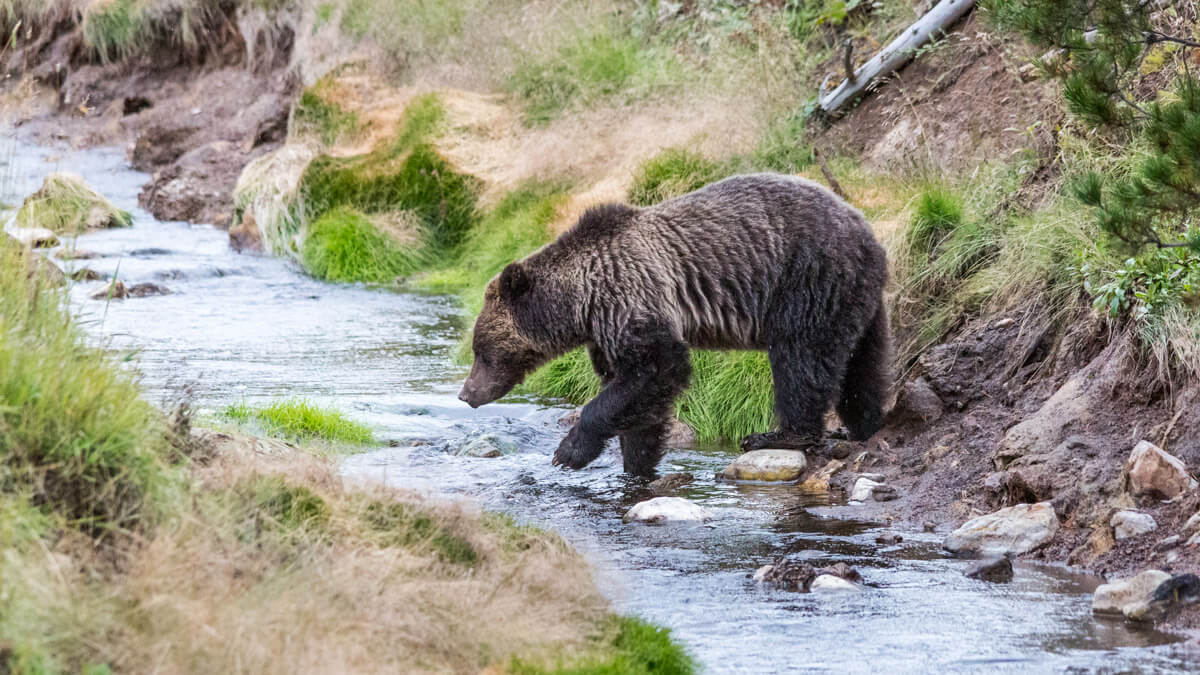
Yellowstone National Park offers one of the most breathtaking wildlife watching experiences in the world, with its vast and diverse ecosystem home to over 67 species of mammals, 322 species of birds, and a rich variety of plants. While the thrill of spotting moose, bison, elk, and even bears draws countless visitors each year, it’s crucial to remember that these animals are truly wild—and must be treated as such. Approaching wildlife, no matter how tempting, is both dangerous and illegal. Animals, especially those with young, can react unpredictably when they feel threatened, sometimes resulting in serious injury or worse. To protect both yourself and the animals, always maintain a safe distance: at least 25 yards from large mammals and 100 yards from bears and wolves. Feeding wildlife is also strictly prohibited, as human food can harm their health and alter their natural behaviors. Responsible wildlife watching means respecting boundaries, observing from afar, and letting nature remain wild.
Yellowstone Forever supports a wide variety of vital wildlife research and monitoring efforts throughout the park. Learn all about the Yellowstone Wolf Project, the Bison Conservation & Transfer Program, the Yellowstone Bird Program, and more at https://www.yellowstone.org/wildlife-conservation-research/.
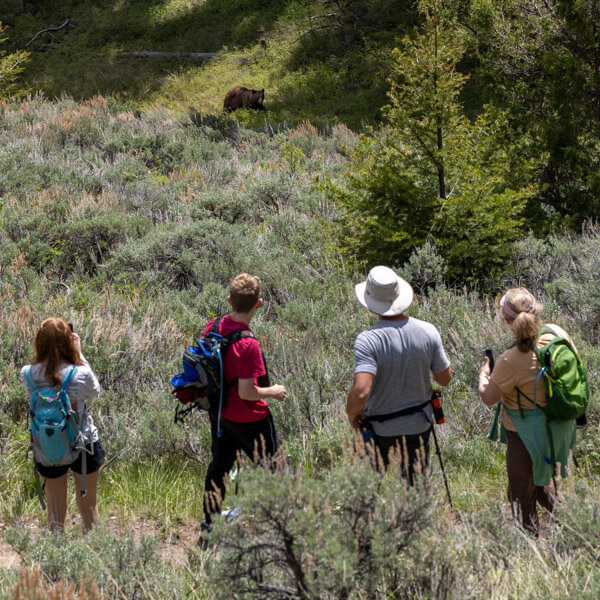
Hikers watching black bear. YF / Matt Ludin
A SPECIAL NOTE ABOUT BEARS
Never get within 100 yards of a bear. Hike in groups of three or more. Carry bear spray and know how to use it. Hikers can lessen the danger of a sudden encounter (the cause of most bear-related injuries to humans) by making noise as they walk, especially in areas where vision is restricted. Avoid animal carcasses and do not hike after dark. If you encounter a bear, do not run, since bears are fast sprinters. If the bear is unaware of your presence, detour away from the animal; if it sees you but does not act aggressively, slowly back away. If you are attacked, lie on the ground, face down, completely flat. Spread your legs and clasp your hands over the back of your neck. Remember, odors attract bears. Keep a clean camp and hang all food and odorous items (such as soap and deodorant) as far from your sleeping area as possible and at least 10 feet above the ground and 4 feet out from tree trunks. Or stow such items in a car or car trunk. If you have a conflict with a bear, report it to a park ranger as soon as possible.
WHERE ARE THE BEARS?
Those who visited Yellowstone many years ago will recall the common sight of bears begging for food in developed areas, even feeding in open garbage dumps. Over time many bears not only became used to human food, but they also grew increasingly bold in their efforts to find it. The dumps were finally closed in the late 1960s, bear-proof garbage containers were installed, and an educational campaign was launched to keep people from feeding the bears. As a result, both grizzly and black bears have returned to their natural feeding habits.
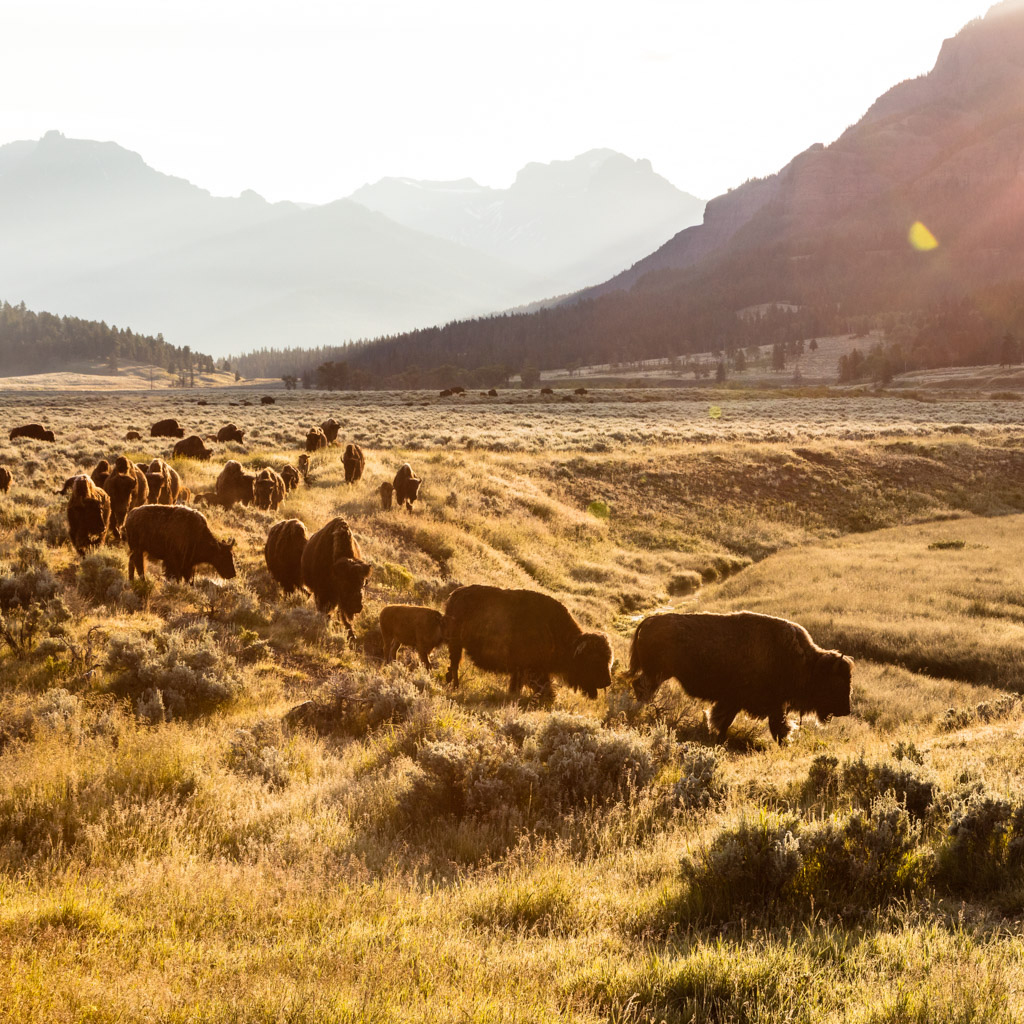
Bison herd in Lamar Valley. NPS / Jacob W. Frank
BISON
Visitors in late July to mid-August stand a good chance of seeing the rut (breeding season), which is marked by bulls pushing and shoving each other for breeding privileges. Single calves are born in late April and May. Look for bison in Lamar Valley and Lower Geyser Basin, along the Madison River, and in Hayden Valley. Large numbers winter in the Lamar Valley, in the Pelican Valley, and along the Firehole River.
PRONGHORN
Sometimes mistakenly called antelope, pronghorn are the fleetest of Yellowstone’s animals, able to run for short distances at speeds of 45-50 miles per hour. In winter, pronghorn are found at low altitudes, especially in grassy areas below Mammoth Hot Springs; in spring, pronghorn migrate up the Yellowstone River to the Lamar Valley. They are rarely seen at high altitudes.
MULE DEER
The name comes from the deer’s very large, mule-shaped ears. Not as numerous as elk; look for mule deer (also called blacktail deer) in the park’s open forests and meadows. Male deer, elk, and moose shed their antlers each year and grow new ones, which are protected during growth by a soft covering called velvet.
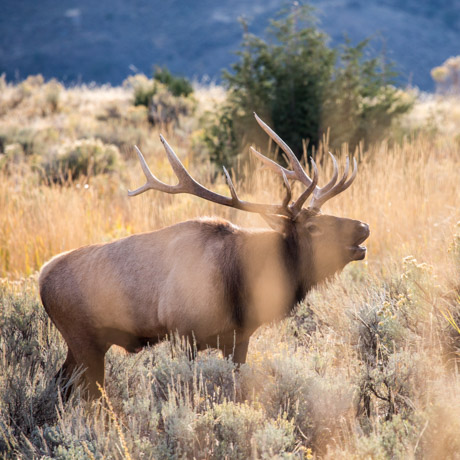
Bull elk bugle. NPS / Neal Herbert
EIK
Elk are tan colored with a dark brown head and neck and a buffcolored rump patch. Bulls begin to grow antlers in early spring, soon after shedding those from the previous year. Summer visitors will find these antlers covered in a soft skin, commonly known as velvet, which provides nourishment to the antlers as they grow. Besides being smaller, females do not have antlers. Bulls begin to “bugle” a high-pitched whistling sound in late August. Elk are seen in all habitats, but tend to be in high country midsummer through fall, and then return to lowland valleys for the winter months.
MOOSE
During summer this largest member of the deer family frequents marshy meadows and edges of lakes and streams. To keep from sinking in mud while feeding, as the animal lowers its foot, a large dewclaw spreads to better support the weight. Similarly, the odd-looking crook of the hind leg allows a moose to pull the leg straight up, more easily releasing it from deep, sucking mud. Male moose shed their antlers in winter, and shortly thereafter begin to grow new ones. Female moose do not have antlers. Take note—cow moose with young can be particularly dangerous.
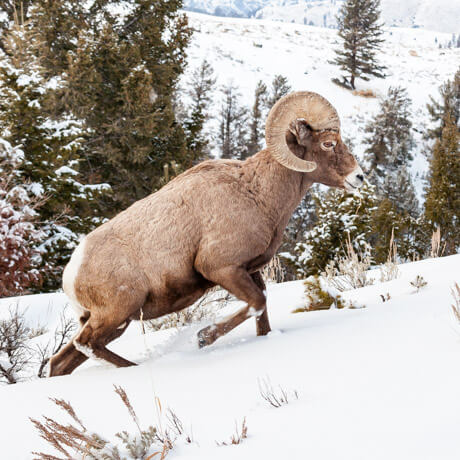
Bighorn sheep, YF / Matt Ludin
BIGHORN SHEEP
In winter these magnificent animals can be found at lower elevations from Mount Everts to Mount Norris; in summer look for them along the trail to Mount Washburn, on Specimen Ridge, and throughout the high country in the northeast portion of the park. Population sizes are highly variable. In late fall, rams battle to establish rank, sometimes lunging at one another with a crack of horns that can be heard a mile away. The horns on a mature male will be fully curled, whereas the horns on females are much shorter, rather like those of a goat, and less thick at the base.
BLACK BEAR
Black bears are common in Yellowstone, especially in the northern third of the park. Like grizzlies, they are largely vegetarian, though most do not hesitate to feed on carcasses. Expect to see black bears in meadows during the summer months, or in forested areas with fruiting plants in the fall. The average weight of adult male black bears in Yellowstone is 210 to 315 pounds. Females weigh between 135 to 200 pounds. Both black bears and grizzly bears range in color from almost buff to brown or black.
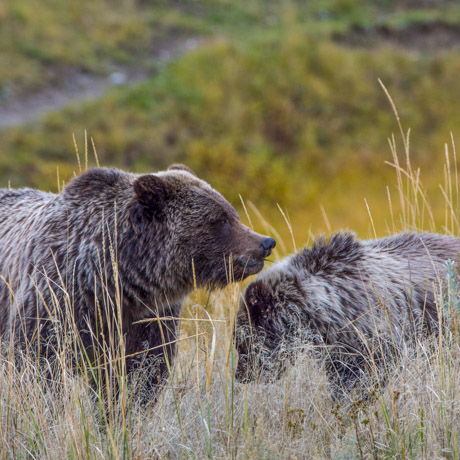
Grizzly boar and sow, YF / Amanda Evans
GRIZZLY BEAR
A grizzly bear can be distinguished from a black bear by the distinct hump on its back, as well as by a face that is somewhat “pushed in,” or dished, between the forehead and nose. The long claws of the grizzly allow it to dig easily for roots and bulbs, rip apart logs for insects, and even excavate burrows for ground squirrels. Grizzlies and black bears are considered true hibernators, but they do sometimes awaken and leave their dens during the winter. Average adult male bears in Yellowstone weigh 200 to 700 pounds, while females range from 200 to 400 pounds.
COYOTE
Coyotes can be seen throughout the park. Their survival is linked to a willingness to dine on a wide variety of foodstuffs, including mice, voles, ground squirrels, and other small mammals. They scavenge large animals killed by other predators, old age, or harsh winters. This habit of feeding on carcasses has sometimes resulted in serious conflicts with wolves that show little tolerance for coyotes scavenging their kills. Yellowstone coyotes are quite large and are often mistaken for wolves.
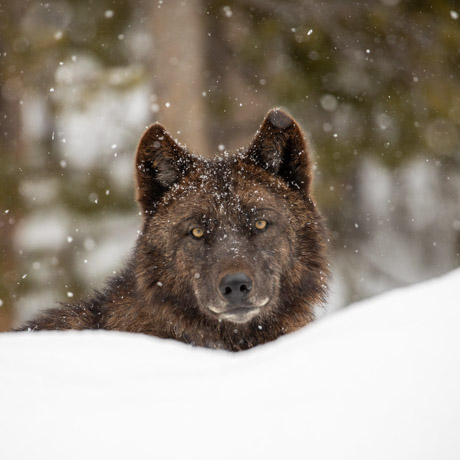
Black wolf, NPS / Jacob W. Frank
WOLF
The wolf is much heavier than the coyote (80 to 130 pounds, compared to 25 to 35 pounds) and longer in the leg. During warm months wolves tend to remain inactive during the day; if you really want to see them, plan to do your watching at dawn. The Lamar Valley can be a good place to watch for these animals, especially from late fall through the end of June. Keep in mind most of Yellowstone’s wolves feed primarily on elk; find the elk, and you stand a better chance of finding wolves.
YELLOW-BELLIED MARMOT
The marmot is common throughout the park in summer, but a long hibernation season—up to eight months—leaves marmots unwatchable for much of the year. Most never stray very far from their dens, which are typically located within the protection of rock clefts or talus. On clear mornings look for them lying or standing on rocks, soaking up the sun. Yellow-bellied marmots are much bigger than ground squirrels; adults weigh in at 3½ to more than 10 pounds, compared to just 7 to 10 ounces for the average Uinta ground squirrel.
UINTA GROUND SQUIRREL
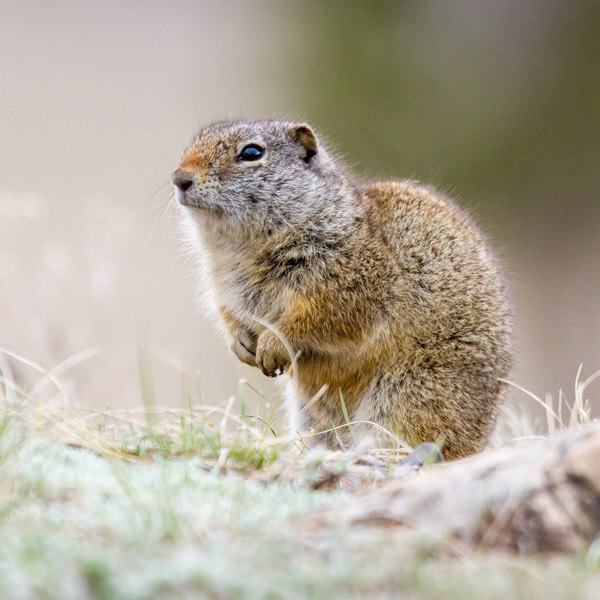
Unita Ground Squirrel, YF / Matt Ludin
Buff colored, the Uinta ground squirrel is common in open, grassy areas amid clumps of sagebrush. In Yellowstone, Uinta ground squirrels are common in the Blacktail Plateau area on the park’s northern range. The squirrels are often also seen on the lawn in front of the Albright Visitor Center at Mammoth. Other ground squirrels include the golden-mantled, which looks rather like a large chipmunk, with a white stripe bordered by black on each side of its body. Please do not feed these or any other Yellowstone wildlife.
CHIPMUNK
Yellowstone’s chipmunks are often seen in forested areas with fallen trees, which make useful runways for traveling back and forth from foraging areas. Where food is plentiful, look for chipmunks to make trip after trip, caching seeds for the winter ahead. The chipmunk’s facial stripes distinguish it from a golden-mantled ground squirrel. No matter how these animals may try to “talk you into it,” please do not feed them, or any other park wildlife.
To learn more about all of Yellowstone’s mammals, visit the park’s official website at https://www.nps.gov/yell/learn/nature/mammals.htm.
RELATED | YELLOWSTONE FOREVER PARK STORE
For information on Yellowstone’s mammals and more, check out these resources available at Yellowstone Forever Park Stores and online. All purchases help support critical projects and programs in Yellowstone National Park.

Comments are closed.