
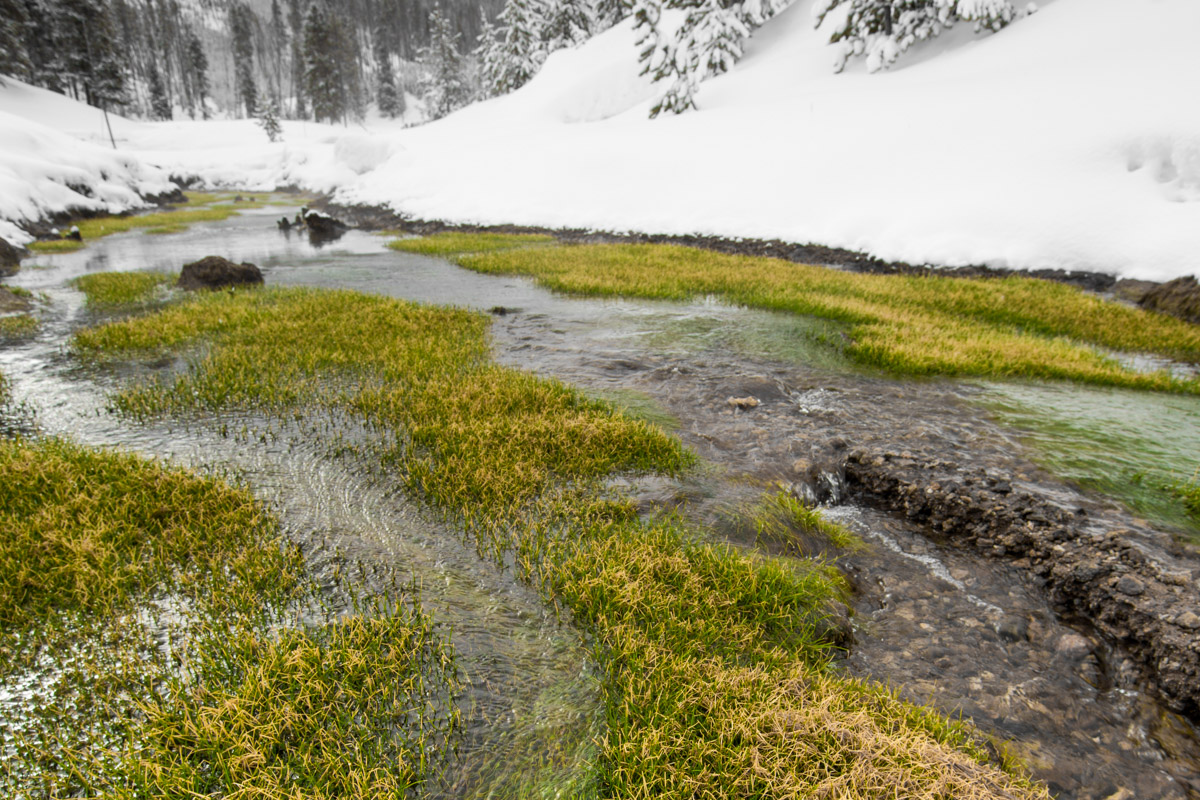

It’s not a prank: April 1st means winter is coming to a close. The sun is shining down along the valleys on a spring morning. The elk and bison turn their faces toward the warmth that is becoming more prevalent every day as they prepare to calve in the coming weeks of April and May. Bears are emerging from their hibernation dens. Mountain bluebirds, red-tailed hawks, and other migratory birds return to the park over the course of several weeks, circling patterns across the sky. Green grasses begin to start poking through the melted snow at lower elevation in Yellowstone, though the mountains hold onto their thick snow caps. Every part of the land becomes a new color in Yellowstone paint palette as April blossoms across the landscape.
It would seem that the earth is awakening from the dark months of winter. Most places in the northern hemisphere must wait for these key seasonal transitions to start up growth and breeding cycles, but Yellowstone has something special that helps jumpstart growth: geothermal activity.
 Yellowstone sits atop a hotspot, a mantle plume that brings extreme heat within a few kilometers of the earth’s surface. This geothermal energy is what powers the park’s 10,000 hydrothermal features; the hot springs, mudpots, fumaroles, and geysers that make Yellowstone so famous. Even in winter, as the landscape is covered with snow and ice, these features continue to emit energy, releasing hot steam and boiling water into the frigid air. Hydrothermal features are even responsible for snowmelt in some areas of Yellowstone. They keep soils warm and melt snow in geyser basins and even speed up the breakup of ice along Yellowstone Lake or in the park’s other waterways.
 Like many things in nature, hydrothermal features are part of the larger ecosystems in Yellowstone and are the base for many food webs. Hydrothermal basins provide habitat for many species of thermophiles – bacteria, alga, and other species that thrive in extreme heat. They in turn support thermophilic insects like ephydrid flies, a fly that persists in Yellowstone year-round by consuming bacteria in these thermophile communities during their larval stages. Spiders and the Wetsalts Tiger Beetle eat the ephydrids, then birds eat the spiders and tiger beetles. The web continues up the line of consumers of various degrees, all the way to wolves and grizzlies.
The soil in Yellowstone is often slightly acidic, which can make it difficult for plants to grow. However, trees and grasses have adapted to this acidic environment, such as the lodgepole pine tree. Lodgepole pines make up 80% of the forested areas of Yellowstone. These trees offer food and habitat for many animals and were historically used in many ways by Indigenous Peoples. Endemic Yellowstone species, like Ross’s Bentgrass and Yellowstone Sand Verbena, can only grow in Yellowstone’s hydrothermal areas. Grasses that grow in these warm sections offer food during the winter and early spring for ungulates like bison and elk, that would otherwise have to dig through the snow. If energy is saved in looking for sustenance, animals stand a better chance of survival. Besides food, hydrothermal basins also offer some warmth amongst the snow and low temperatures of winter, especially in the interior of the park. Bison are particularly seen near hot springs and runoff areas.
There are many animals and plants that have adapted to survive a harsh winter in Yellowstone. But if the hydrothermal features did not offer the warmth and water that they do, a winter in the park would be that much harder to survive – maybe even impossible. It is easy to be grateful for the new beginnings and warmer weather that spring brings, especially as we get to see the first calves of the year, listen to bird songs that we haven’t heard for months, and smell the first wildflowers as the snow begins to melt on the hillsides. But we cannot forget to be grateful for the little functions that have been happening without us even knowing that helped this joyous springtime unfold throughout Yellowstone.
Photos top to bottom:
-Warm springs spike-rush (Eleocharis flavescens var. thermalis) on Obsidian Creek, NPS / Neal Herbert
-Bluebirds arrive in Yellowstone, YF / Matt Ludin
-Firehole River, boardwalk, and Oblong Geyser, NPS / Jacob W. Frank
-Thermophiles in Porcelain Basin, YF / Matt Ludin
-Bull elk searches for food beneath the snow, NPS / Jacob W. Frank
-Buttercup wildflower covered up by spring snow, YF / Matt Ludin
Comments are closed.