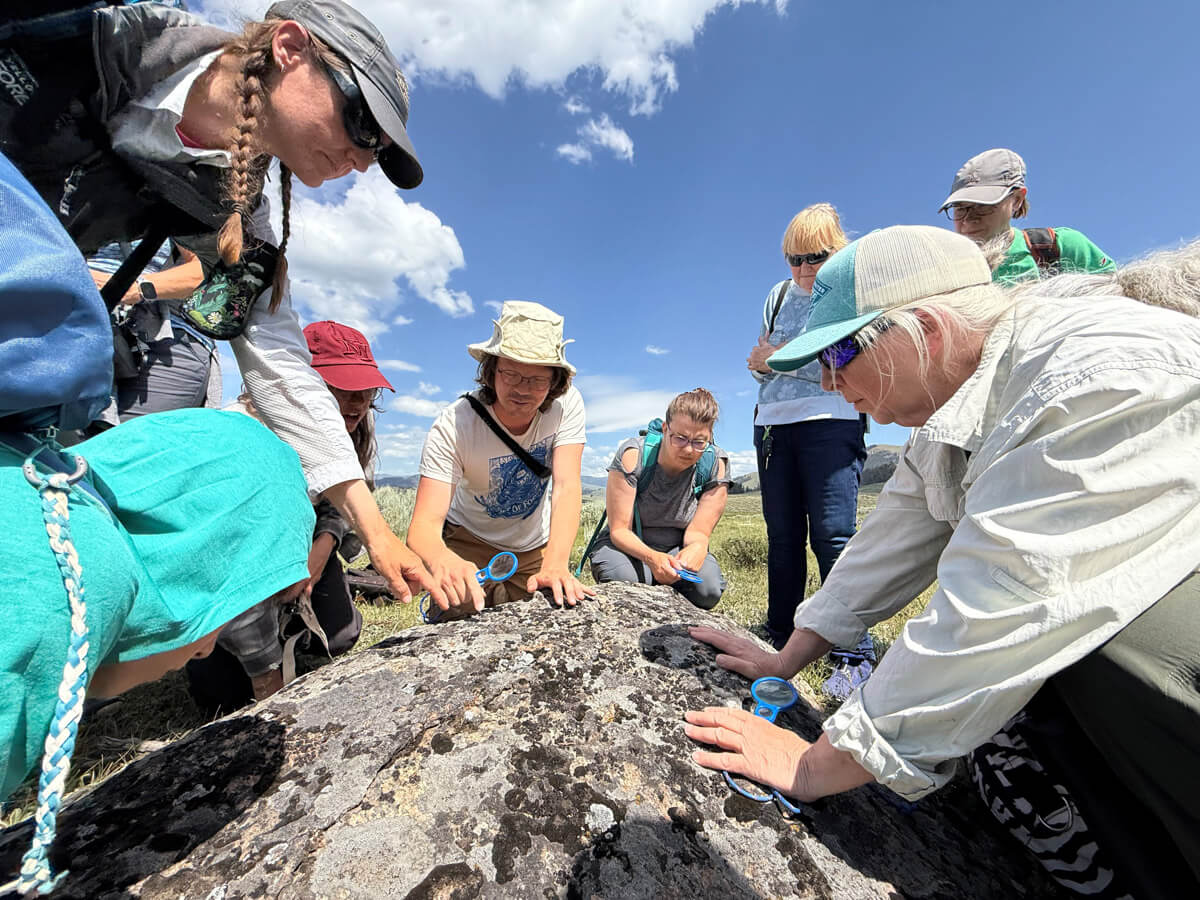
The wildness of Yellowstone is not only in its wolves and geysers – there are countless worlds of struggle and beauty, hidden in plain sight. Cedar Mathers-Winn’s enthusiasm for all that is small in the natural world is palpable. A naturalist, biologist, and educator based out of Bozeman, MT, Cedar will be leading the Field Seminar, Inconspicuous Yellowstone, from June 20-23. We caught up with Cedar to talk about his upcoming course and his passion for ecological stories that are often overlooked. If past reviews are any indication, Inconspicuous Yellowstone is sure to be a hit with all participants. Grab your spot today!
What excites you about exploring different aspects of nature hidden plain in sight?
Learning to look more closely just opens up the world in ways you’d never expect; it starts to feel like anywhere you look, there’s something to be amazed by. The closer you look, the more you see, and the more questions you ask, the more you realize that every organism, big or small, has its own unique and often quite bizarre story, and its own unique place in the ecosystem. That’s all very abstract, but when you zero in on that ant in the chokecherry, and realize it’s drinking something out of the base of a leaf, it’s hard not to wonder what’s going on. And once you learn, you’ll never look at a chokecherry the same way again.
What makes Yellowstone an ideal place make those small discoveries?
One of the beautiful things about these little discoveries is that anywhere you are, there’s the potential to make them. But in a place like Yellowstone, where the ecosystem is nearly intact, they are just everywhere! All those little interactions between species, all those connection points in the web of relationships are still there. It just becomes so much easier to find these tiny little sagas when everything they need to support them is there.
 What keeps you inspired about teaching this topic?
This is one of my favorite things to teach about, because I so often get to blow peoples’ minds! Most folks aren’t thinking about what the bugs are doing, why lichens matter, or if there might be anything living in this pile of bison dung. But once you start to explore those things, to learn about the critters and understand their stories, or just to take the time to watch what they do, it’s hard not to feel a sense of awe. Even though you’re just looking at an ant, now you understand that ant, and that ant is absolutely mind-blowing.
What are some memorable moments from teaching this program in previous years?
One of my favorite Inconspicuous Yellowstone moments came from just sitting and watching an antlion pit. An antlion is a predatory insect, and as larvae they dig these little circular pits in loose dry soil that they use to trap other insects, especially ants. The trap itself is only about an inch across. But when we saw an ant sliding down the sides, and then the antlion hidden beneath flinging sand at it to knock it into the hole, and then slowly dragging it underneath — everyone totally lost it! It was so intense! Folks were saying it was like being in a nature documentary, which is absolutely how it felt. Most people don’t come to Yellowstone to look at antlions, but I’ve rarely seen visitors as excited as this group was watching the mortal struggle between antlion and ant.
 When did you first come to Yellowstone? What were your impressions then?
The first time I came to Yellowstone was as a little kid, and all I really remember was loving the sulfur smell of the hydrothermal features. When I started coming as an adult, I first had this idea that Yellowstone meant wolves, grizzlies, geysers, all the big stuff that’s so much harder to see anywhere else, and if I didn’t see them, it was a wasted trip. When I started to let go of that idea, though, Yellowstone really opened itself up to me, and I started to see that what really makes this place special isn’t just that you can see bears or wolves, but the fact that this landscape is whole. The bears and wolves are part of that, but there are many, many other parts. And with all those parts still there, it’s a place that feels truly wild, and that is very, very special.
What do you hope participants come away with from your Field Seminar this summer?
I hope that participants in this program will learn to look closely, think inquisitively, and appreciate that wherever you look in nature, there are fascinating stories just waiting for you to recognize and give them your attention. This is especially true in Yellowstone, but it’s true everywhere else too. I hope that participants come away from this course equipped to see wildness outside of Yellowstone, in their own backyards.
Comments are closed.