
A look at how species like bison, foxes, and otters adapt to extreme cold and deep snow.
by Kyle Wonders, YF Institute Lead Field Educator
The alarm rings. Long johns on. Coffee. Snow pants on. Mid-layer. Snow bibs. Puffy jacket. Thermos. Snow cap. Extra layer. Sunglasses. Heck, maybe another puffy. Wool socks. Muck Boots. Gloves. Start the car. Scrap the ice off the windshield. Time to go.
To exist in Yellowstone in the winter takes some serious consideration. Thankfully humans have the option of staying inside when it gets a little too chilly or storms are a bit too thick. Wildlife species don’t have that option. The species that call Yellowstone home have gone through thousands of years of evolution causing adaptations that make them specifically well-suited to the environment that is brought about by the winter season. The bison, red fox, and otter are all great examples of how winter survival is not a matter of one adaptation, but rather the complex interactions of several factors that make these animals capable of surviving the landscape’s harshest season.

NPS / Jacob W. Frank
American bison are built for winter. Being such massive animals, they retain heat easier than other species with smaller bodies and lower surface area-to-volume ratios. This phenomenon, known as Bergmann’s Rule, is a general trend that suggests it is more common for mammals to be larger when they experience climates that are typically colder. With more core volume, they are losing much less heat to their ambient environment than a smaller animal would whose surface area to body volume ratio is much higher. Bison also grow a thick winter coat that is renowned for its ability to keep them warm in intensely cold conditions. Their winter coat has an average of 20,000 hairs per square inch. This insulates them so well that snow will accumulate atop a bison’s coat and not melt from their body heat! For comparison, research found that the average human has about 1,150 hairs per square inch (although notably there is quite a range depending on the person). While they have the warmth figured out, bison still need to access grass for forage, which could be buried under multiple feet of snow. Bison have a solution to this predicament. Many park visitors often suspect that the hump of a bison may be a place for fat storage like a camel, but in fact a bison’s hump is a built-in snowplow! This hump is full of musculature that helps to control and support head movement. These large muscles not only help stabilize the head during the battles of the breeding season, but they also allow bison to use their face to clear swaths in the snow by swinging their head in a sweeping motion. Once the snow is clear, they are free to graze away. It’s worth noting that bison moving across the landscape also causes the formation of wildlife “highways” where they have compressed down the snow. This acts as a huge benefit to species, like coyotes or elk, who can use these highways as an easier way to get around.
NPS / Neal Herbert
Other species, like red fox, blaze their own trail. Or rather, they go their own way leaving only shallow footprints in the snow. The red fox has a radically different physiology compared to the bison, but it is also uniquely adapted for winter. Foxes make up for their diminutive body size through extra thick winter coats. While there are some differences across foxes of different ages, research has found them to have coats upwards of 76,000 hairs per square inch! While this hair density is significantly higher than the 20,000 of the bison, that can be expected. Remembering back to Bergmann’s Rule, it is energetically favorable to be bigger in cold climates. Therefore, a small critter like a red fox has to find another way to cope. By having a fur coat that’s nearly 4 times as dense as a bison, they have done just that! To take full advantage of their coats, when it’s time for them to sleep, they will curl up and use their own tail to keep their face warm, which is not only effective, but adorable.
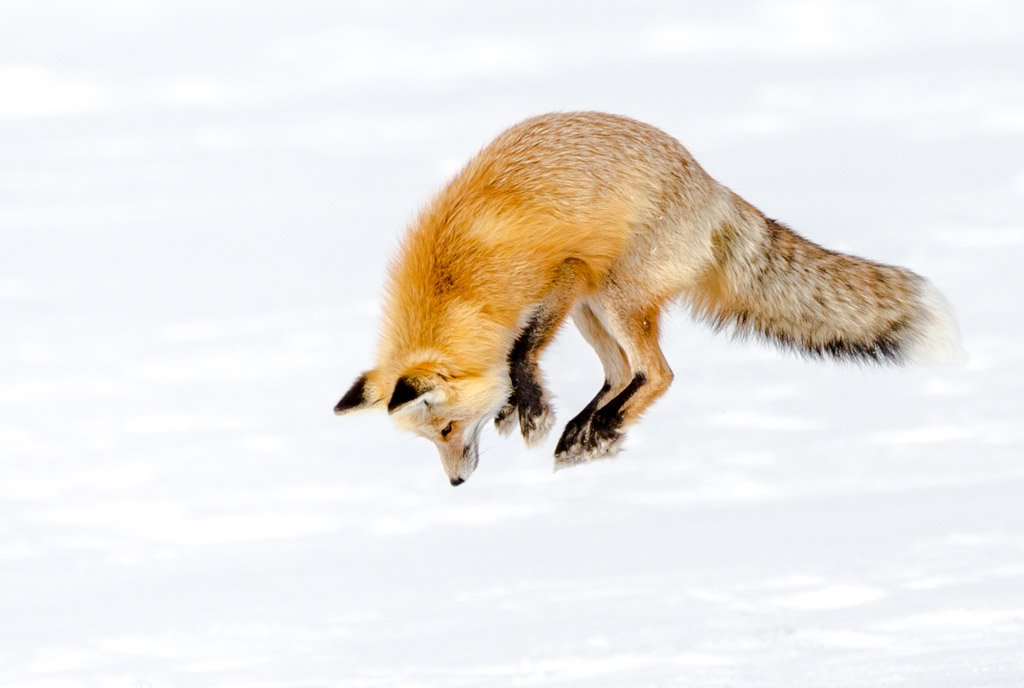
When it comes to finding food, foxes rely on an innate part of their biology: auditory bullae. These bubble-like structures found on the bottom of their skulls help them locate small rodents buried deep under the snow. Many mammals have auditory bullae, but those of a fox take up an extra-large portion of the skull compared to closely related species like coyotes or grey wolves. This demonstrates their incredible importance to the fox’s way of life. Foxes ‘mouse’ to find food, a hunting technique that involves patrolling the surface of the snow listening to movement beneath the surface of the snow. When they hear a squeak, scurry, or shuffle of a small critter below, they will slowly approach, homing in on the muffled mouse’s exact location. Once they have determined that position, they crouch, (often give a little tail waggle) and pounce up and into the air, before rotating over, and falling jaws first into the snow. Because of their acute sense of hearing, they are able to perform this acrobatic feat successfully enough to make it through winter, surviving on several rodents a day.
YF / Matt Ludin
Land mammals, be they big as a bison or small as the fox, have the advantage of staying dry. Aquatic mammals must contend with frigid waters. Most aquatic mammals account for exposure to cold water through the development of a thick layer of fat, often called blubber. Instead, the river otter has a highly specialized coat that holds a significant pocket of air between their exterior guard hairs and their interior undercoat. This strategy is similar to how native songbirds, like the Black-Capped Chickadee, survive, but even more specialized. The hairs within the otter’s undercoat contain a microscopic texture that allows them to interlock and impede water from saturating down to the skin. This allows river otters to stay warm in conditions that would be hypothermic for humans! Additionally, river otters are adept at moving across the snow through their notorious belly slides, and they frequently will build semi-permanent snow dens in order to take advantage of the thermally insulating powers of snow. They are also frequently observed playing in fresh snow. For all of us who get out and recreate during wintertime, we know how important playing in powder can be.
These three species are just breaking the ice as to how wildlife works to survive the harshest season in this ecosystem. In fact, the diversity of strategies for coping with winter correlates well with the diversity of life within this wonderful place. Though there are many similarities, each species has its own unique set of strategies for survival. These strategies combine multiple independent adaptations that make life through the winter possible. To truly appreciate them all, you have to be out on the landscape, watching these animals hunt, play, feed, and survive, and braving the cold along with them.
by Kyle Wonders, Yellowstone Forever Institute Lead Field Educator
Comments are closed.