
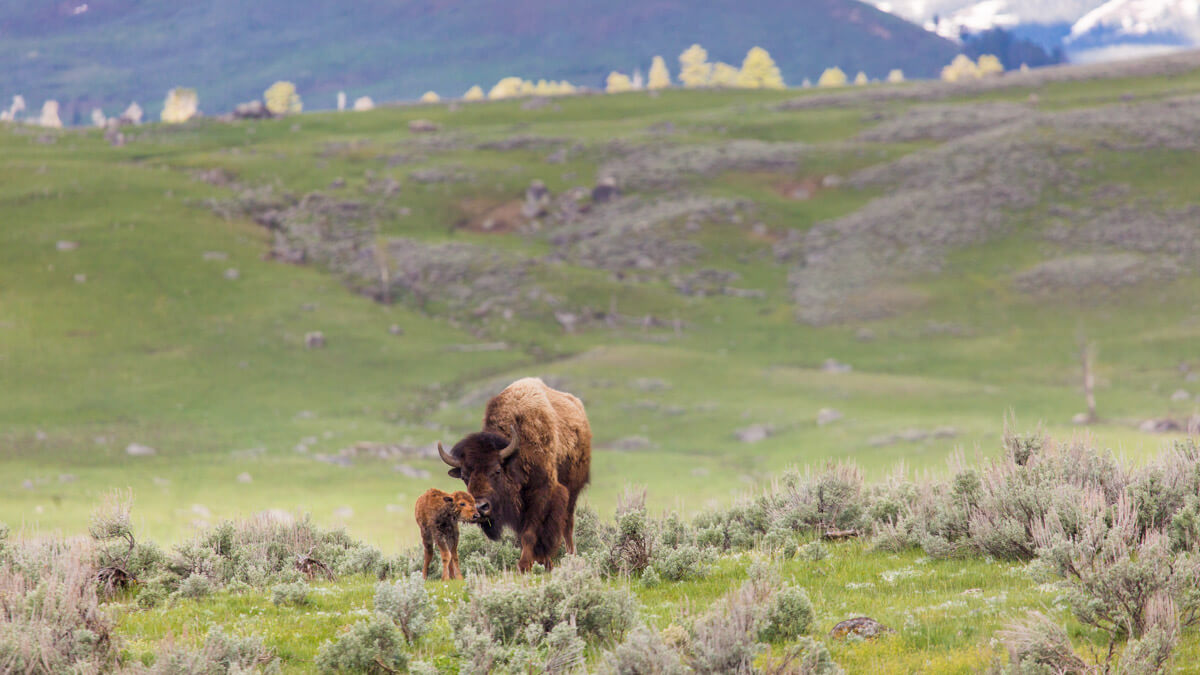
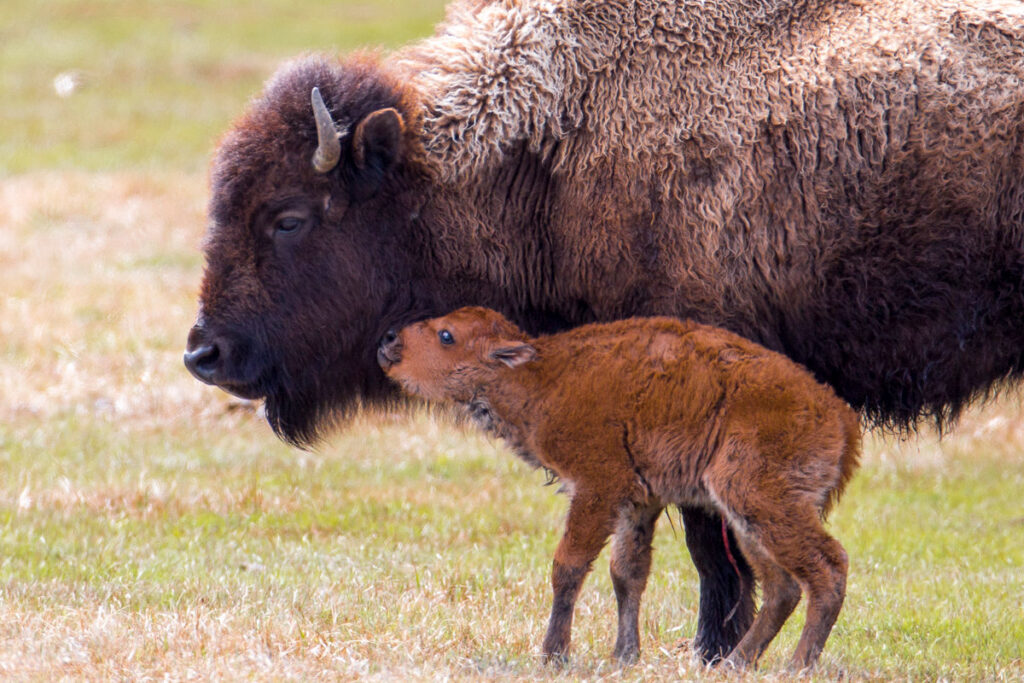
 In the hush of a late May morning, a bison cow steps away from the herd and chooses a patch of open ground where she can see in all directions. The birth comes quietly, though not always quickly. Some births can take hours, but this one goes smoothly. Within minutes, and with one final strain, a wet dark calf spills onto the grass, small against the vastness of the valley. Steam rises from its body in the cool air as the mother turns to lick him clean. Her steady labor of love removes any birthing fluids that might attract predators and stimulates his first breaths. It also helps the newborn imprint on her scent, creating a bond that will define the pair’s next year of life. Within minutes, the calf stirs, legs trembling, drawn upward by instinct and necessity alike. He takes his first teetering steps a few minutes later, less than an hour after his birth.
There is little time for hesitation in Yellowstone, even in its first moments, the young must begin learning how to live.
A bison’s first steps are instinctual, a pattern written into the body long before birth. Many of the core processes for Yellowstone’s young – movements, alarm signals, or defense strategies – are hardwired into their DNA. Other behaviors though, such as food selection, predator recognition, migration movements, or social behavior depending on the species, must be learned. For chicks, calves, and cubs, survival depends less on instinct alone than on the gradual accumulation of knowledge: what to eat, where to step, when to run, and what to fear.
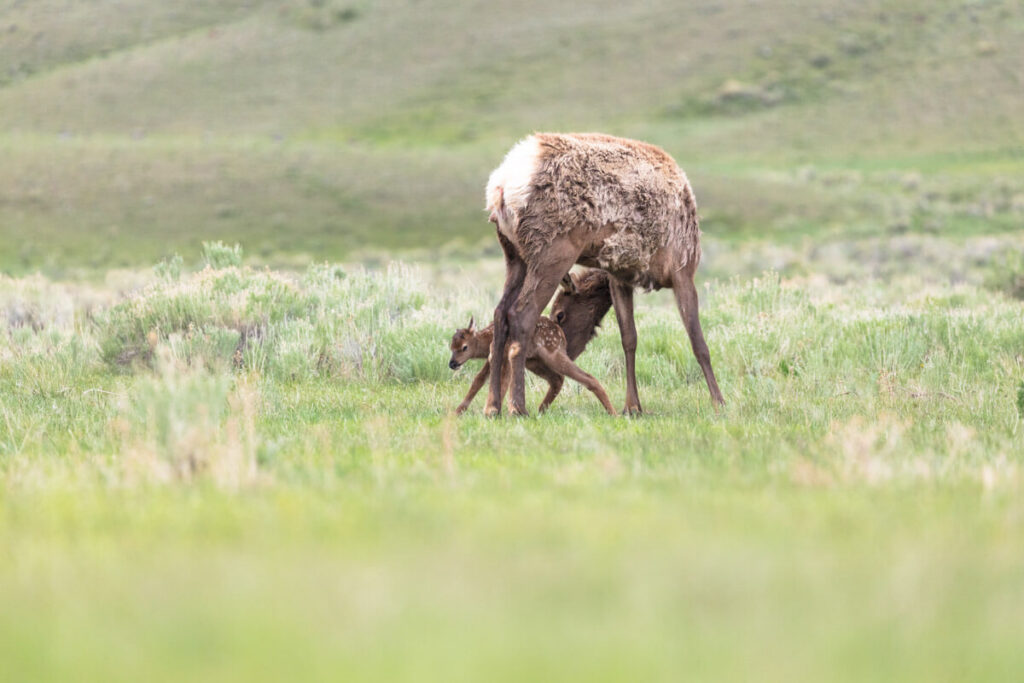 For the hoofed mammals, learning starts almost immediately. An elk calf, unsteady on its legs, enters a world already thick with risk. Their first lessons are quiet ones: stay still, remain hidden, trust the tall grass. The calf’s spotted coat dissolves its outline, but camouflage alone cannot guarantee safety. The mother’s behavior is the deeper curriculum. She chooses bedding sites with care – slight depressions, downwind of open views – and returns on a schedule that balances feeding her young with avoiding detection. The calf learns the rhythm of stillness and movement, absorbing without conscious thought the idea that survival is often a matter of timing.
Predators complicate every lesson. Wolves do not appear often, but their presence is constant in the behavior of the herd. A shift in posture – a raised head, a sudden stillness – travels through the group faster than any spoken warning. Calves learn to read these signals the way humans read facial expressions: a subtle change in tension means something unseen has entered the valley. The first time a calf runs in earnest, bounding after its mother with startling speed, it is responding to a threat it may not yet fully understand. But repetition builds recognition. Over time, the shape of danger becomes clearer in the way shadows move, the meaning of pursuit, the importance of staying within the protective geometry of the herd.
For birds, the classroom is often more immediate and more individual. A Sandhill Crane chick steps into a world where food must be found, not delivered. Within hours of hatching, it begins pecking, guided by instinct but refined through trial and error. Not every movement in the grass is edible. Some insects are nutritious, others distasteful or even dangerous. The chick learns quickly, associating taste and texture with future choices. In this way, its diet becomes a map of past experiences.
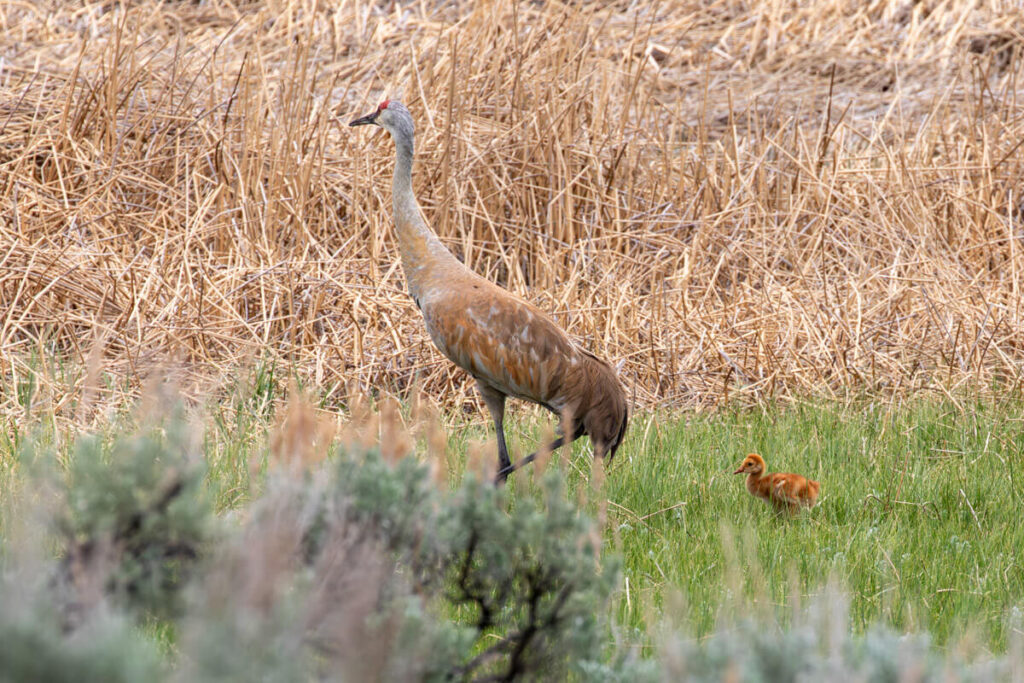 Parents play a decisive role here as well. Adult cranes demonstrate where to forage, typically wet meadows along the edges of shallow ponds. The chick follows, copying both location and technique. This is cultural transmission on a small scale: knowledge passed through behavior. Timing again proves critical. Peak insect abundance aligns with the rapid growth of chicks, and the young birds must learn efficiently while food is plentiful. A delay in these lessons can ripple outward, affecting growth rates and, ultimately, survival.
For carnivores, the education is perhaps most visible in its progression. A young fox or wolf pup begins life dependent, nourished by adults who bring food to the den. But dependency fades quickly. Play becomes practice. Pouncing on siblings, stalking insects, tugging on pieces of hide – these actions are more than idle games. They are rehearsals for the precision required in hunting. Through play, a pup learns coordination, timing, and the subtle art of reading another creature’s movement. It’s not just the newborns who must learn. Yearling wolves in their second year of life must learn what it means to be part of a pack. They observe the care with which older adults bring food and toys (things like elk antlers, skulls, maybe even traffic cones) to the den sites. Yearlings are often ineffective helpers when it comes to feeding or defending the pack, but their time is coming soon.
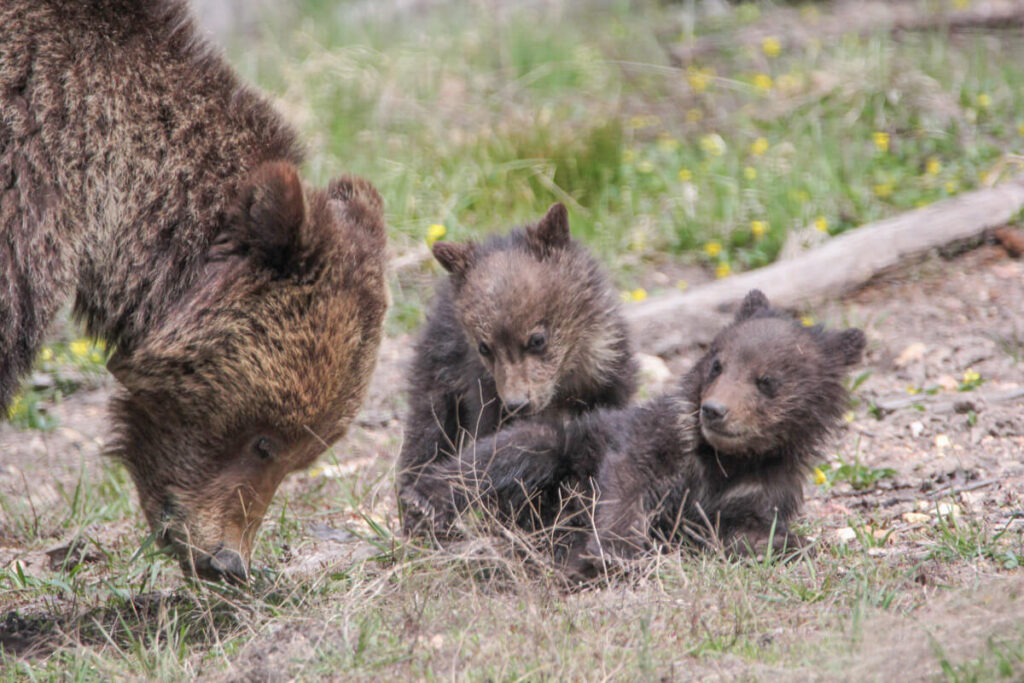 Bears are less social carnivores, but their education is just as important. Researchers have documented over 260 different food sources for Grizzly Bears in Yellowstone. Young cubs must learn not only what these foods are, but where they are and when to eat them. Many bears travel dozens of miles across the greater Yellowstone ecosystem at certain times of the year to seek out high protein food sources like Army Cutworm Moths or Whitebark pinecones. Grazing is not simply eating; it is discriminating. Cubs mirror their mothers, sampling what she selects, ignoring what she passes, and travelling where she goes. By the time young bears are finally pushed out in their second or third summer, they’re ready to meet the high caloric demands needed to prepare for hibernation on their own.
Ultimately, the line between instinct and learning is not fixed. It is a blurry, complex self-reinforcing relationship where inherited impulses are shaped and refined through experience. What begins as a built-in response gains meaning through repetition, context, and correction. Mothers, most often, but occasional fathers or other elders, anchor this process, translating the world of threats and opportunities into a known landscape. In Yellowstone, survival is rarely the product of instinct alone; it is the result of behaviors taught and modeled until the learned feels as natural and immediate as the instinct that began it.
by Yellowstone Forever Field Educator Manager, Sam Archibald
Click here to learn about our wide variety of Yellowstone Forever Institute programs and tours.
Photos top to bottom:
Feature, Bison cow and calf, NPS / Neal Herbert
Newborn bison calf with mother, NPS / Neal Herbert
Newborn elk calf with cow, NPS / Jacob W. Frank
Sandhill crane with chick, NPS / Ashton Hoooker
Grizzly with two cubs, NPS / Eric Johnston
Comments are closed.