
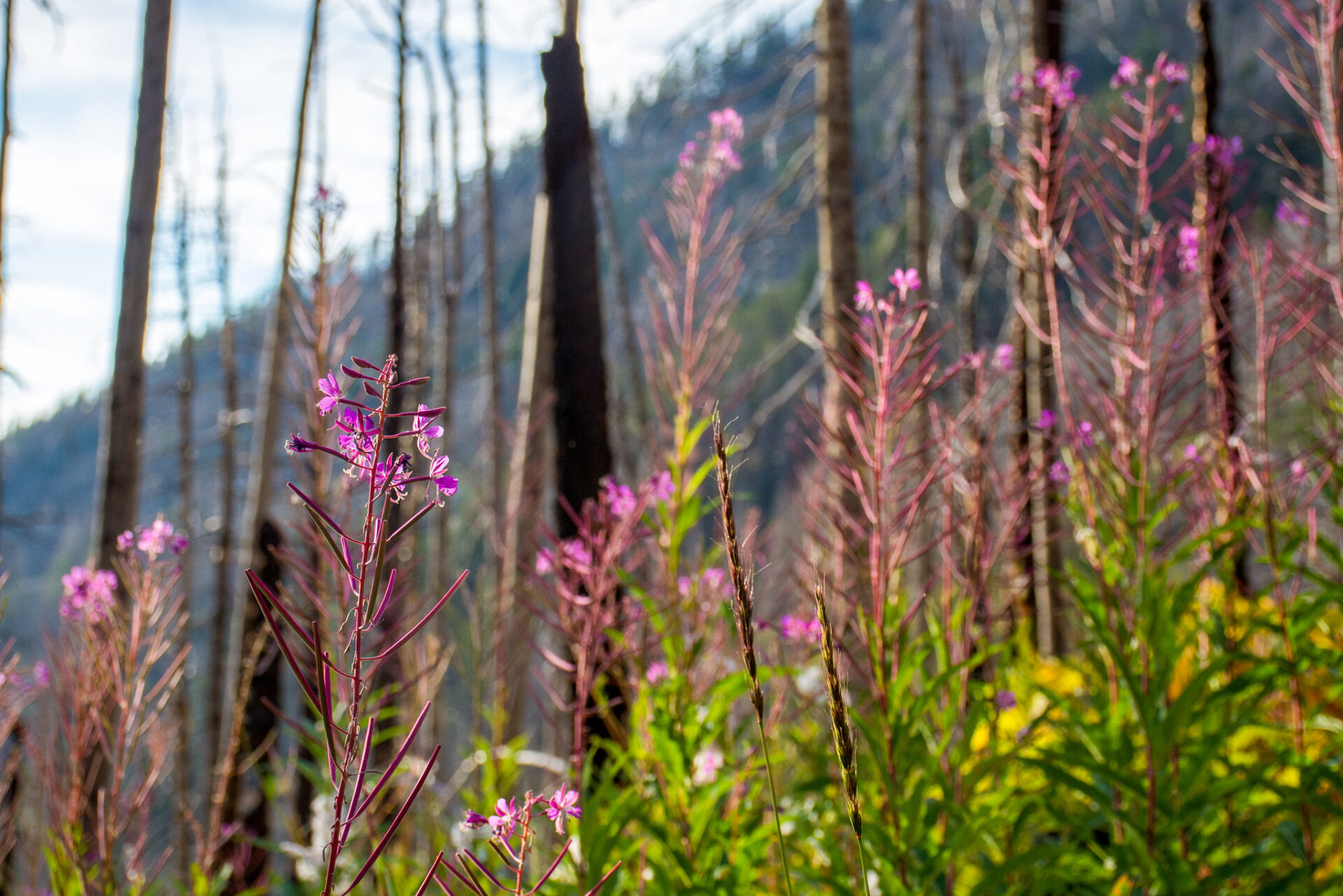
How plants, animals, and even insects adapt to wildfire season.
By Amanda Evans, Institute Lead Field Educator
 When fire sweeps through human communities, it can be devastating. In wild landscapes, however, fire plays a vital ecological role. It recycles dead vegetation, returns nutrients to the soil, creates new habitat, and resets portions of the ecosystem. By burning unevenly across the landscape, fire creates a mosaic of habitats in different stages of growth, increasing biodiversity and supporting a wide variety of species.
In regions where fire has been a natural force for thousands of years, plants and animals have evolved strategies to cope with, survive, and even benefit from this landscape-scale disturbance. Most animals can move away from low- to moderate-intensity fires, while many plants possess remarkable adaptations that allow them to withstand fire or use it as an opportunity to reproduce.
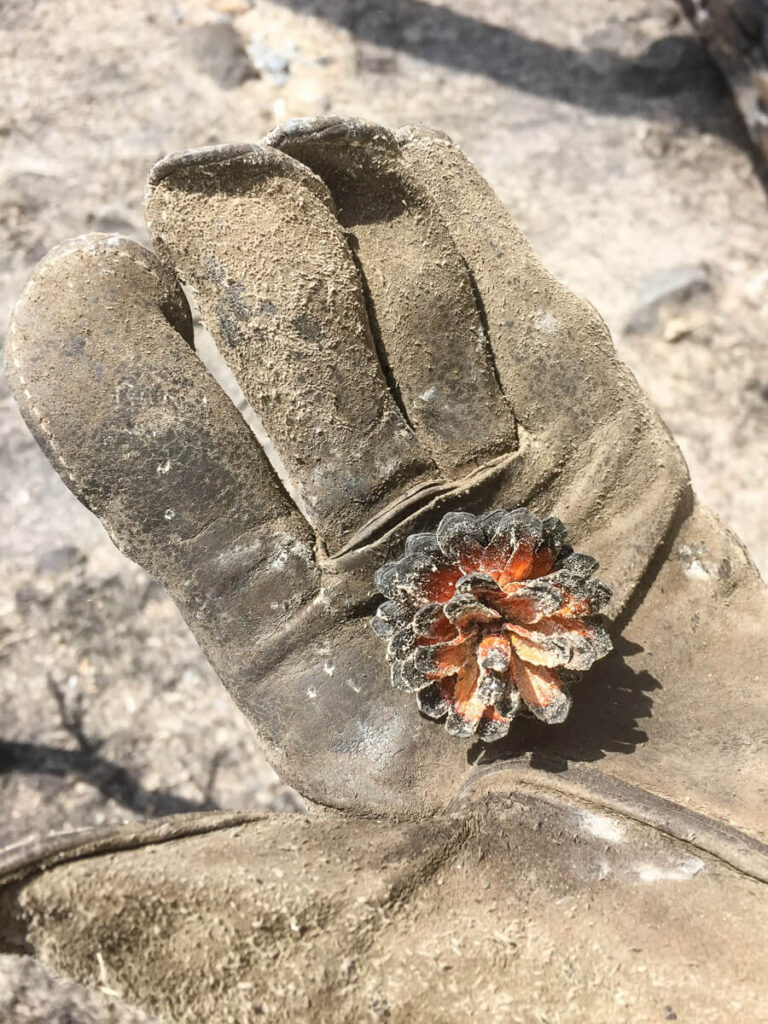
The lodgepole pine may be the most famous. Jokingly referred to as ‘Pinus monotonous’ for the seemingly endless expanses of lodgepole trees along Yellowstone roadways, lodgepole forests make up roughly a whopping 64% of Yellowstone National Park, making them the dominant forest type across much of the landscape. The species is particularly well suited to Yellowstone’s volcanic soils. Its shallow root system allows it to thrive in the rocky, rhyolitic soils formed by past volcanic activity, often making it one of the first tree species to colonize an area after disturbance. Its reproductive strategy is equally impressive. While some lodgepole pines produce typical open cones, many also produce serotinous cones, which are sealed shut with resin. These cones can remain closed for decades, storing seeds until the heat of a fire melts the resin. Following a wildfire, thousands of seeds may be released onto nutrient-rich soil and exposed sunlight, quickly carpeting the burned landscape with young lodgepole seedlings.
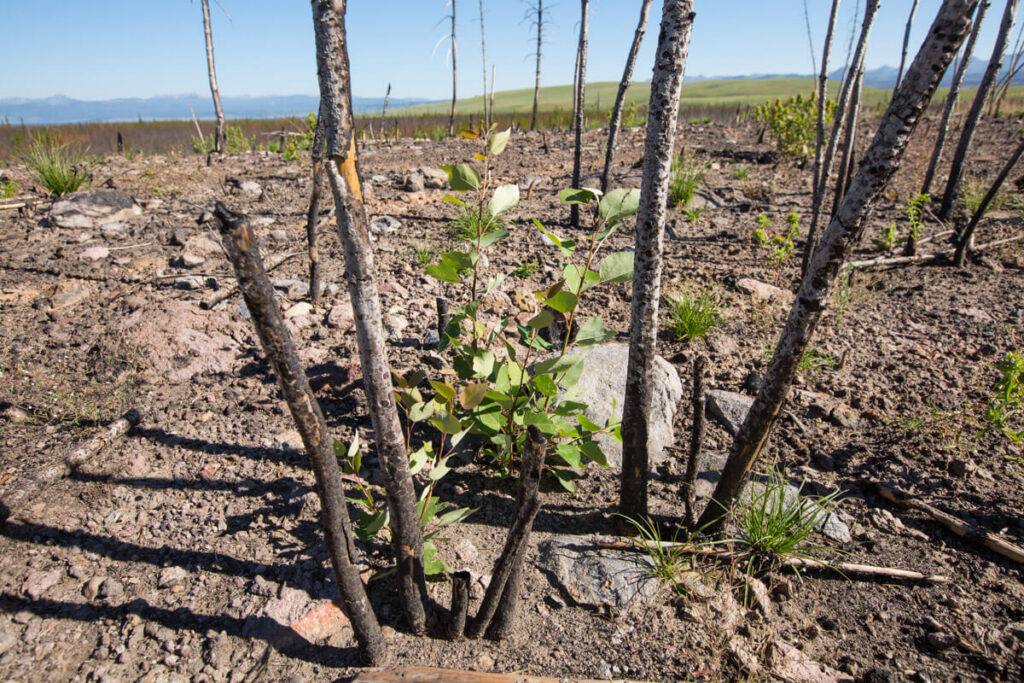 Other tree species rely on different strategies. Douglas-firs develop thick, deeply furrowed bark that helps insulate them from heat and increases their chances of surviving lower-intensity fires. Aspens and cottonwoods are commonly found along streams and wetlands, where moist conditions can provide some protection from fire. Aspen trees are particularly resilient because the visible trunks are connected by a shared underground root system. Even if a fire kills individual stems, the parent root network often survives and sends up new shoots in the years that follow. This strategy allows some aspen clones to persist for millennia. The most famous example is Pando, a massive aspen clone in Utah that spans approximately 106 acres. Estimated to weigh more than 13 million pounds and be at least
9,000 years old, Pando is considered one of the largest and oldest living organisms on Earth.
Animals have their own fire-related adaptations. Several beetle species are considered pyrophilic, or “fire-loving.” Beetles in the genera Melanophila and Sericoda are attracted to smoke and heat, often arriving shortly after a fire begins. They seek out freshly burned, and sometimes even actively burning, areas where they can mate and lay eggs in newly charred wood or soil. By doing so, they take advantage of habitats with reduced competition and abundant resources.
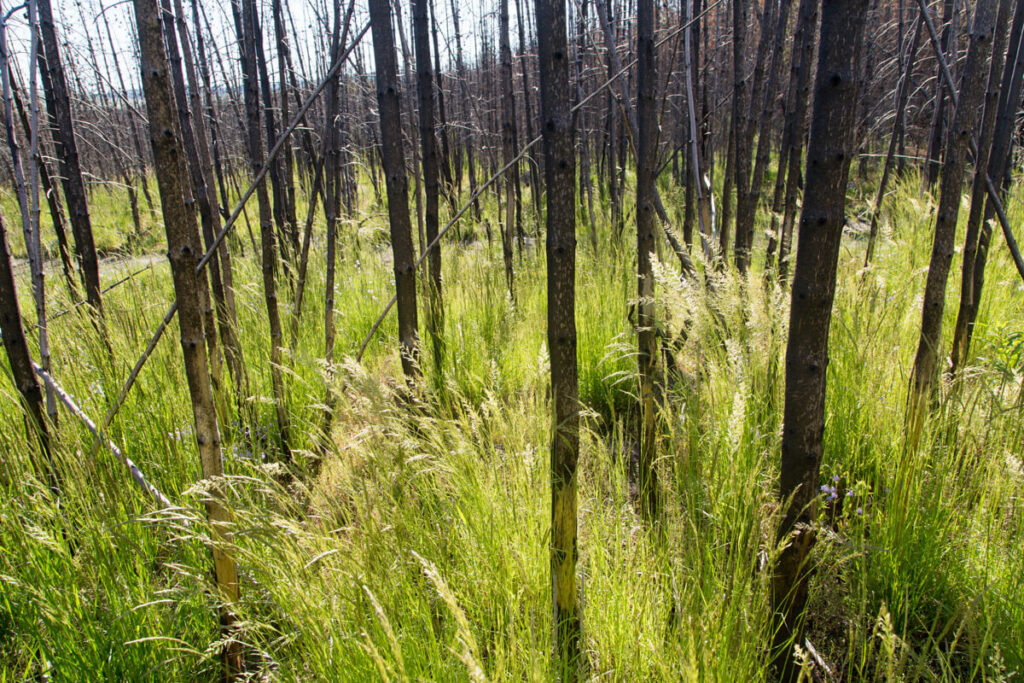 Many species also benefit from the ecological changes created after a fire. Sun-loving plants that struggle beneath a dense forest canopy suddenly gain access to light, nutrients, and growing space. Fireweed, aptly named for its ability to rapidly colonize burned landscapes, is often among the first plants to flourish after a fire. Numerous grasses, wildflowers, shrubs, and tree species follow, taking advantage of the newly opened habitat and nutrient-rich ash left behind.
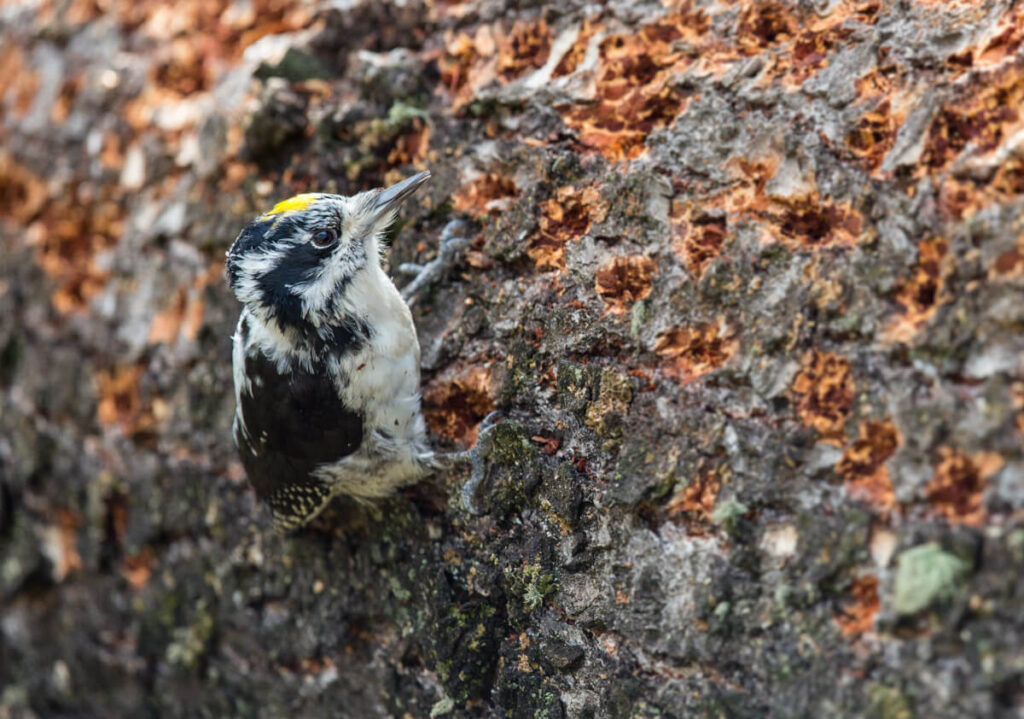
The effects ripple throughout the food web. Dead and dying trees provide habitat for carpenter ants and other insects, creating feeding opportunities for species ranging from woodpeckers to bears. Woodpeckers, in turn, excavate nesting cavities in fire-killed trees. These cavities are later used by a variety of other birds, including bluebirds, swallows, American kestrels, and northern pygmy-owls, extending the ecological benefits of fire well beyond the burn itself.
 Most fires in Yellowstone are relatively small. Approximately 76% of fires in the park burn less than a quarter acre, and about 92% remain under 100 acres. Lightning is responsible for roughly 78% of Yellowstone’s fires, while human activities account for the remaining 22%. Since reliable fire records began in 1972, Yellowstone has averaged about 24 fires and 5,466 acres burned each year.
Recent decades, however, have shown a shift in fire patterns. Between 1994 and 2023, Yellowstone experienced fewer fires annually on average than in earlier decades, yet the total acreage burned each year increased. This trend reflects broader changes occurring across western North America.
Climate change is altering the conditions that influence wildfire activity. More winter precipitation falls as rain instead of snow, causing water to run off earlier in the year and increasing the likelihood of dry conditions during summer. Yellowstone is also experiencing fewer freezing days in spring and fall, along with warmer summer temperatures. As growing seasons become longer and hotter, the park’s ecosystems will continue to change in ways scientists are still working to understand.
Despite these uncertainties, one thing is clear: fire will remain a defining force in Yellowstone. Far from being merely destructive, it is an essential ecological process that shapes the landscape, drives renewal, and helps sustain the remarkable diversity of life found throughout the Greater Yellowstone Ecosystem.
Source: https://www.nps.gov/yell/learn/nature/fire.htm
Photos:
Feature: Fireweed, YF / Amanda Evans
Top to bottom:
Lodgepole pinecone after burn, NPS / Jennifer Jarrett
Aspen seedlings after fire, NPS / Neal Herbert
Pinegrass under standing dead trees, NPS / Herbert Neal
Three-toed woodpecker on fallen dead tree looking for insects, NPS / Neal Herbert
Comments are closed.